


mutable.ai
Build together with AIExplore AI Tools
Overview
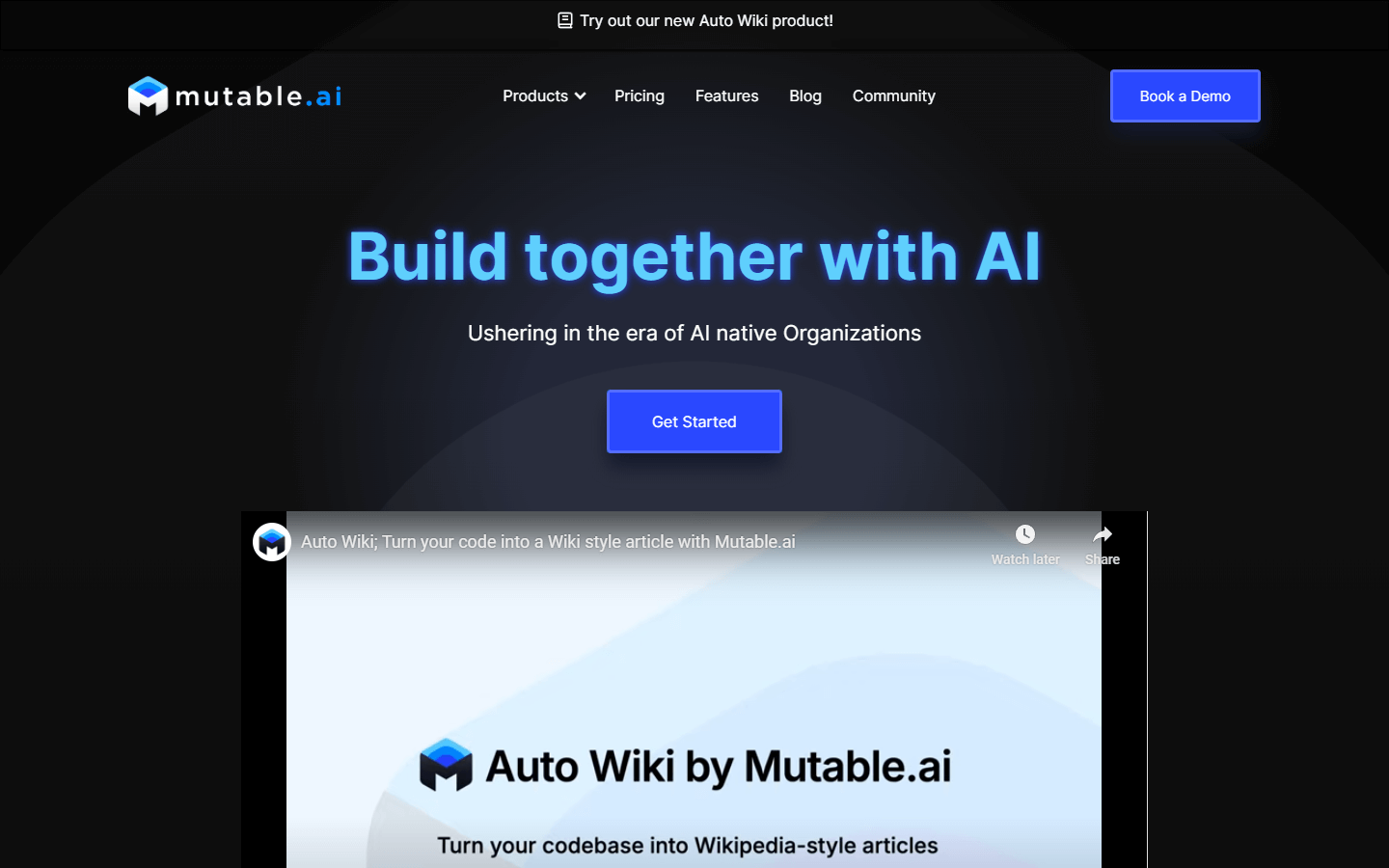
Mutable.ai is a company that develops AI-powered tools to help organizations improve their workflow and documentation. Their flagship product is an AI-generated wiki that can automatically convert code and other sources of information into easily digestible articles.
One of the key features of Auto Wiki is its ability to generate Wikipedia-style articles from code. This means that Auto Wiki can take your code and automatically create a well-structured and informative article that explains what the code does. This can be a huge time-saver for developers, as it eliminates the need to manually write documentation.
In addition to generating articles from code, Auto Wiki can also update documentation automatically when there is a change to the code. This means that your documentation will always be up-to-date, even if your code is constantly evolving.
Overall, Mutable.ai’s Auto Wiki is a powerful tool that can help developers to improve their workflow and documentation. If you are looking for a way to automatically generate and update documentation, then Auto Wiki is definitely worth checking out.
Core Features
Automatically converts code into easy-to-understand, Wikipedia-style articles: This means that Auto Wiki can take your code and automatically create a well-structured and informative article that explains what the code does. This can be a huge time-saver for developers, as it eliminates the need to manually write documentation.
Automatically updates documentation when there is a change to the code: This means that your documentation will always be up-to-date, even if your code is constantly evolving.
Creates citations to the original source material: This ensures that your documentation is accurate and well-sourced.
Visually represents code: This can make it easier for people to understand complex code.
Use Cases
Individual Developer Workflow:
Accelerate personal project development: Quickly generate documentation as you code, reducing context switching and saving time.
Ensure code quality: Leverage AI suggestions to write clean, well-structured, and commented code that adheres to best practices.
Level up coding skills: Learn from the AI's insights and examples to improve your understanding of code patterns and algorithms.
Team Collaboration:
Streamline knowledge sharing: Create and maintain a centralized wiki of code documentation accessible to all team members.
Onboard new team members faster: Provide readily available documentation for existing codebases, speeding up integration.
Reduce communication overhead: Eliminate the need for manual documentation updates, fostering clearer understanding and smoother collaboration.
Software Product Documentation:
Generate user guides and technical manuals: Convert code logic into clear and concise explanations for users of varying technical expertise.
Maintain consistent API documentation: Automatically update API reference materials whenever code changes are implemented.
Improve customer support: Enable support teams to access readily available technical details for faster issue resolution.
Enterprise Knowledge Management:
Document internal systems and processes: Automate the creation of internal wikis, reducing reliance on manual documentation efforts.
Centralize knowledge bases: Facilitate easy access and sharing of critical information across teams and departments.
Improve knowledge transfer: Ensure smooth transitions between team members with readily available, up-to-date documentation.
Open-Source Project Development:
Maintain high-quality public documentation: Automatically generate accurate and consistent documentation for open-source projects.
Encourage community contributions: Improve project accessibility and attract developers with well-explained code logic.
Reduce maintenance burden: Minimize manual documentation updates while ensuring open-source knowledge remains readily available.
Research and Development:
Document experimental code and prototypes: Capture critical details and logic behind research projects for future reference.
Share research findings with collaborators: Generate clear and concise summaries of code functionality for dissemination.
Replicate research results: Facilitate future research by offering well-explained and documented codebases.
Technical Training and Education:
Create interactive coding tutorials: Automatically generate code explanations and exercises for students or trainees.
Develop self-paced learning materials: Make technical knowledge accessible through easily digestible and visual code representations.
Personalize learning experiences: Cater content to different learning styles by combining code explanations with visualizations and examples.
DevOps and Continuous Integration:
Automate documentation updates within CI/CD pipelines: Ensure documentation always reflects the latest code changes.
Improve traceability and auditability: Maintain a clear record of code evolution and changes implemented.
Streamline release management: Facilitate smooth releases with readily available and accurate documentation.
Security and Compliance:
Auto-generate security best practices documentation: Integrate security considerations into code documentation for improved awareness.
Maintain compliance documentation: Automatically update records to reflect changes in code that impact compliance requirements.
Improve security audits: Facilitate efficient audits by providing readily available and transparent documentation.
Data Science and Machine Learning:
Document data pipelines and models: Capture the logic and purpose behind data workflows and ML algorithms.
Improve reproducibility of research: Ensure experiments and results can be easily replicated and understood by others.
Facilitate knowledge sharing within data science teams: Foster collaboration and understanding by documenting complex data and ML processes.
Pros & Cons
Pros
Time-saving: Automate documentation, free up developer time for coding.
Accuracy: Generate consistent, factual docs based on code itself.
Efficiency: Update docs automatically upon code changes, reduce manual effort.
Accessibility: Create clear, Wikipedia-style articles for easy understanding.
Collaboration: Improve team knowledge sharing with centralized wiki system.
Onboarding: Accelerate new team member integration with readily available docs.
Knowledge Transfer: Ensure smooth transitions with up-to-date documentation.
Open Source: Encourage contributions with well-explained code logic.
Education: Develop interactive coding tutorials with explanations and exercises.
Security: Integrate security best practices into code documentation.
Cons
Limited understanding: AI cannot always grasp complex code nuances.
Initial setup: Requires integration and configuration for specific codebases.
Bias: AI models can inherit biases present in training data.
Error propagation: If code has errors, generated docs might misrepresent it.
Style variations: May require manual adjustments for consistent writing style.
Over-reliance: Could discourage developers from fully understanding code.
Cost: Paid service, might not be feasible for all projects or budgets.
Limited customization: Might not offer deep customization for specific needs.
Control: Developers cede some control over documentation presentation.
Security risks: Potential vulnerabilities if integration or access control is weak.
FAQs
mutable.ai Alternatives

Freed AI

Owlbot

Mistral AI
