
Overview
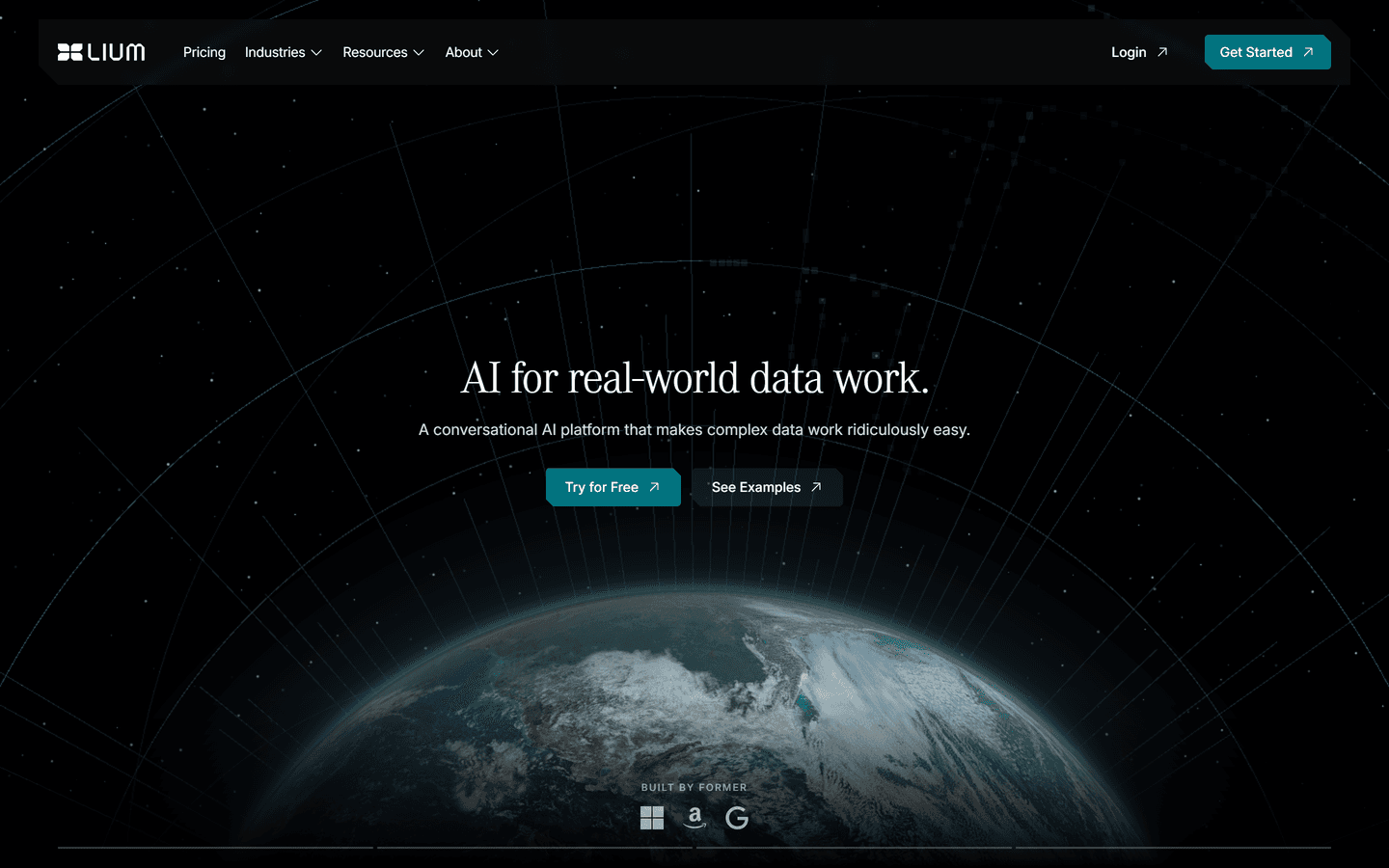
Lium is a collaborative AI platform for complex, real-world data science that is built for scientists, analysts, and domain experts, not just engineers. Attach your data, ask questions in plain English, get reliable answers.
Core Features
Lium is an AI platform that helps teams get reliable answers from large, complex, multimodal datasets.
It was built for the kind of data work that traditional AI tools cannot handle: scientific measurements, sensor streams, geospatial imagery, seismic surveys, engineering models, technical documents, instrument outputs, proprietary files, and other messy datasets from the physical world. These datasets power critical work in advanced industries like energy, climate, infrastructure, space, geoscience, engineering, and scientific research, but they are often too large, fragmented, or domain-specific for generic AI systems to reason over reliably.
Lium gives experts a direct way to work with that data. Scientists, engineers, operators, analysts, and subject matter experts can describe what they want to learn in natural language, and Lium handles the technical work behind the scenes: connecting disparate data sources, processing terabyte-scale workloads, provisioning compute as needed, building reusable analysis tools, running tests, and producing knowledge artifacts that experts can inspect and validate. Instead of waiting on custom pipelines or rebuilding scripts for every new question, teams can move from raw data to useful answers in a matter of minutes.
This means anyone in an organization can ask what they want of their data without infrastructure, scale, or software complexity standing in the way. And when an analysis is validated, it does not disappear into a notebook or one-off report. It becomes a reusable capability that the rest of the organization can run, trust, and build on.
For teams working on high-stakes problems in the physical world, Lium makes large, complex data usable. It turns raw information into trusted answers, repeatable workflows, and organizational knowledge that compounds with every project.
Use Cases
Natural-Language Analysis of Complex Data
Query large, complex, and multimodal datasets using natural language
Explore relationships across multiple data sources
Investigate anomalies and patterns without custom code
Accelerate data exploration and hypothesis testing
Automated Technical Analysis Workflows
Automate scientific and engineering analysis processes
Standardize workflows across teams and projects
Reduce reliance on manual data processing
Enable repeatable and scalable analysis
Knowledge Capture and Institutional Memory
Transform expert workflows into reusable capabilities
Preserve organizational knowledge over time
Reduce knowledge silos and dependency on individual experts
Build a growing library of validated analyses
Cross-Modal Data Integration and Exploration
Connect disparate datasets across formats and systems
Analyze structured, unstructured, and multimodal data together
Unify fragmented data environments
Enable holistic investigation across data sources
Energy
Reservoir and subsurface analysis
Seismic data interpretation
Asset performance monitoring
Infrastructure health assessment
Climate and Environmental Science
Climate data analysis
Weather and environmental monitoring
Risk assessment and forecasting
Large-scale environmental data exploration
Geospatial Intelligence
Geospatial data analysis
Satellite imagery interpretation
Spatial trend identification
Location-based intelligence workflows
Engineering and Manufacturing
Equipment health monitoring
Predictive maintenance workflows
Failure and root-cause analysis
Operational performance optimization
Space and Aerospace
Scientific mission data analysis
Remote sensing workflows
Observatory and instrument data interpretation
Large-scale research data exploration
Scientific Research
Multi-dataset research analysis
Experimental data interpretation
Research workflow automation
Cross-disciplinary knowledge discovery
Pros & Cons
Pros
- Handles heterogeneous data sources seamlessly
- Scales to terabyte-class datasets
- Natural language queries lower the learning curve
- Automated compute reduces DevOps overhead
- Reusable artifacts prevent duplicated work
- Strong cross-domain reasoning capabilities
- Collaboration features for team workflows
- Enterprise-ready security and governance
- Fast time-to-insight with indexed sources
- Free tier to evaluate with real data
Cons
- Complex setups may need initial configuration
- Advanced features require paid plan
- Large compute may incur extra costs
- Learning curve for custom agent design
- Onboarding integrations can take time
Video Review
FAQs
Lium Alternatives

AI Image Humanizer
mavic.ai

Jsonify
